

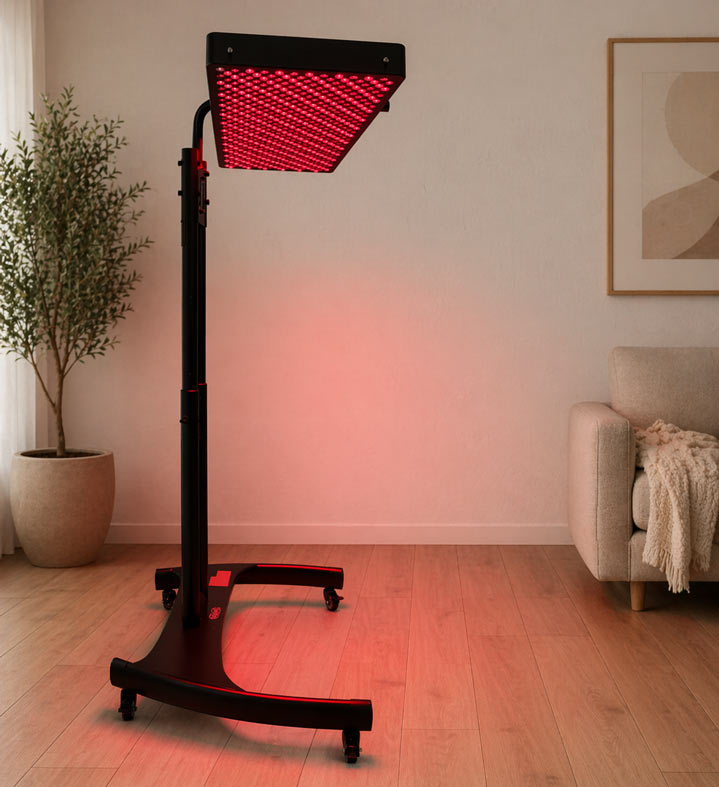
Red light therapy has gone from niche biohacker territory to mainstream wellness in the space of a few years. You’ll find it in elite sports recovery suites, dermatology clinics, and increasingly, people’s living rooms. But does it actually work — or is it another wellness trend dressed up in scientific language?
Here’s what the evidence says.
Red light therapy — also called photobiomodulation (PBM) or low-level laser therapy (LLLT) — uses specific wavelengths of red and near-infrared (NIR) light to penetrate the skin and stimulate biological processes at a cellular level.
The key wavelengths used therapeutically are typically between 630–850nm. Red light (630–700nm) works primarily at the skin surface, while near-infrared light (700–850nm) penetrates deeper into muscle tissue, joints, and even bone.
The mechanism is well-established: these wavelengths stimulate the mitochondria — the energy-producing structures inside your cells — to produce more ATP (adenosine triphosphate), which is the fundamental fuel for cellular repair and function.
Think of it like photosynthesis, but for your cells. Light in, energy out — which then accelerates the body’s own healing and regeneration processes.
This is arguably the most well-researched application of red light therapy. Multiple randomised controlled trials have shown that pre- or post-exercise red light therapy reduces muscle soreness, decreases markers of inflammation, and improves recovery between training sessions.
A 2016 systematic review published in the European Journal of Sport Science found consistent evidence that photobiomodulation therapy reduced delayed onset muscle soreness (DOMS) and improved recovery times in trained athletes. The effect is thought to work by reducing oxidative stress and inflammatory cytokines produced during intense exercise.
For athletes, weekend warriors, or anyone with a physically demanding lifestyle, this has real practical implications — faster recovery between sessions, less soreness, and the ability to train harder with less downtime.
Red light therapy has a solid evidence base in physiotherapy and sports medicine for accelerating soft tissue healing. Studies have shown benefits in the treatment of tendinopathies, ligament injuries, and post-surgical recovery. It’s used widely in professional sports teams precisely because the evidence supports it and the risk profile is negligible.
Several studies have demonstrated benefits for people with joint conditions including osteoarthritis and rheumatoid arthritis. A 2009 Cochrane Review — one of the most rigorous forms of evidence synthesis — found that low-level laser therapy significantly reduced pain and morning stiffness in rheumatoid arthritis patients compared to placebo.
The dermatological applications of red light therapy are perhaps its most commercially visible use — but the science behind them is real.
Red light at 630–670nm has been shown in multiple studies to stimulate fibroblast activity — the cells responsible for producing collagen and elastin. The result is measurable improvements in skin texture, firmness, and the reduction of fine lines over consistent use. A 2014 study in Photomedicine and Laser Surgery found significant improvements in skin complexion and collagen density in participants using red light therapy twice weekly over 30 sessions.
Red and near-infrared light have demonstrated anti-inflammatory effects on the skin, making them useful in managing acne, rosacea, and psoriasis. The evidence here is less uniform than for collagen production, but the anti-inflammatory mechanism is well understood and clinical results are generally positive.
Emerging research points to red light therapy’s influence on circadian rhythms. A 2012 study published in the Journal of Athletic Enhancement found that whole-body red light therapy significantly improved sleep quality and melatonin levels in elite female basketball players — without the side effects of supplementation.
The cognitive benefits are linked primarily to improved sleep quality, reduced stress, and enhanced mitochondrial function in brain tissue — particularly relevant for near-infrared light, which can penetrate to neural tissue at higher intensities.
Worth being honest here: red light therapy is not a cure-all. It works best as a recovery and optimisation tool, not a treatment for serious medical conditions. The evidence is strongest for muscle recovery, skin health, and inflammation reduction. Claims around weight loss or dramatic hormonal changes are less well-supported.
Consistency matters too. A single session will produce some effect, but the real benefits accumulate over weeks and months of regular use — much like exercise itself.
At Heila Wellness, we offer red light therapy as part of our mobile wellness service — bringing professional-grade panels directly to your home or venue. We also stock a range of red light therapy devices through Heila Hytte, our equipment shop, including full-body panels with stands, therapy blankets, and targeted face masks.
Whether you’re looking to accelerate recovery between training sessions, support skin health, or simply add a proven recovery modality to your weekly routine, red light therapy is one of the most accessible and well-evidenced options available.
Explore red light therapy hire and purchase options → Heila Hytte | Book a mobile session → Contact Heila Wellness
Red light therapy isn’t hype. The photobiomodulation research is extensive, peer-reviewed, and consistently positive for muscle recovery, inflammation, skin health, and sleep. It works at a fundamental cellular level — stimulating the body’s own energy production and repair mechanisms — and the risk profile is essentially zero when used correctly.
If you’re serious about recovery, performance, or long-term skin health, it deserves a place in your toolkit.
Most people notice improvements in skin texture and reduced muscle soreness within 2–4 weeks of consistent use. For deeper benefits — collagen remodelling, joint pain reduction, sleep improvement — the research typically shows meaningful changes after 8–12 weeks of regular sessions. Consistency is key; sporadic use produces limited results.
For most applications, 3–5 sessions per week produces the best results. Each session is typically 10–20 minutes. Daily use is safe and may produce faster improvements, particularly for skin health goals. Rest days aren’t required — unlike resistance training, red light therapy doesn’t require recovery time between sessions.
Red light therapy has an excellent safety profile. The main precautions are avoiding direct eye exposure (always use protective goggles), caution with photosensitive medications, and checking with a GP if you have a history of skin cancer. It is generally not recommended during pregnancy due to limited research, not evidence of harm. For the vast majority of people, it is safe and side-effect free.
Red light therapy uses specific wavelengths (630–850nm) to directly stimulate cellular processes — particularly mitochondrial ATP production and collagen synthesis. Infrared sauna uses heat to induce a stress response and cardiovascular adaptation. They work through different mechanisms and produce different benefits. Many people use both — they complement rather than replace each other.
Yes — and this is one of its biggest advantages. Home panels, blankets, and face masks make red light therapy accessible without clinic visits. The key is choosing a device with the right wavelengths (630–850nm) and sufficient irradiance (power output). Heila Hytte stocks home-use devices across all price points, and we also offer hire options if you want to trial before committing.
Share This :
